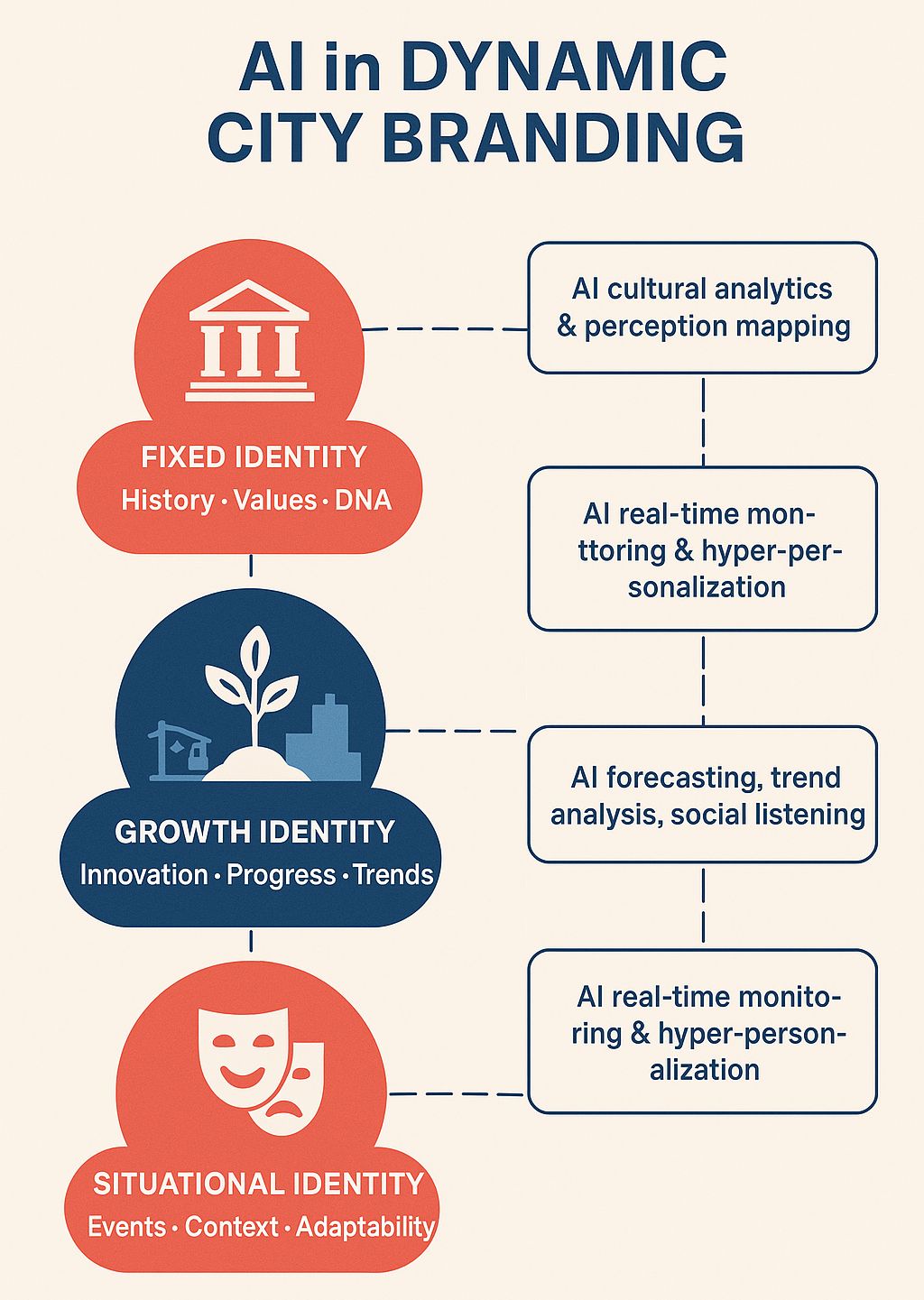
Cities today are no longer just geographic locations, they are living, evolving brands. From culture and architecture to innovation and diversity, every element contributes to how a city is perceived. As urban environments become more complex, traditional branding approaches are no longer enough. This is where the Alport-Moghaddam model of dynamic branding offers a powerful foundation, and when combined with Artificial Intelligence, it unlocks entirely new possibilities.
At its core, the Alport-Moghaddam system is built on three layers: Fixed Identity, Growth Identity, and Situational Identity. Together, they form a holistic approach to branding that reflects both stability and change.
Fixed Identity represents the timeless essence of a city, its heritage, culture, and core values. AI enhances this layer through cultural data analysis, helping us understand how both residents and global audiences perceive a city. By analyzing patterns in language, imagery, and sentiment, AI ensures that a city’s story remains authentic and deeply rooted in its history while still resonating with modern audiences.
Growth Identity focuses on evolution. Cities continuously transform due to technological innovation, migration, and sustainability initiatives. AI plays a crucial role here by predicting trends, tracking tourism behaviors, and analyzing public sentiment in real time. This allows city planners and marketers to make informed decisions and adapt branding strategies that align with the future, not just the present.
Situational Identity is about adaptability. Cities must respond quickly to changing contexts, whether it’s hosting international festivals, responding to crises, or launching global campaigns. AI-powered tools enable real-time monitoring and hyper-personalized communication, ensuring that messaging is always relevant, timely, and impactful.

This approach is especially important for cities like Toronto, Vancouver, and Montreal, urban ecosystems that thrive on diversity, innovation, and global connection. By integrating AI into the Alport-Moghaddam framework, these cities can build brands that are not only visually compelling but also intelligent, responsive, and human-centered.
The future of city branding is not static; it is dynamic and data-driven. AI does not replace creativity; it amplifies it. When strategy meets intelligence, cities don’t just grow, they evolve with purpose.
What do you think about AI shaping cities? Share your thoughts in the comments or explore more insights in my blog.